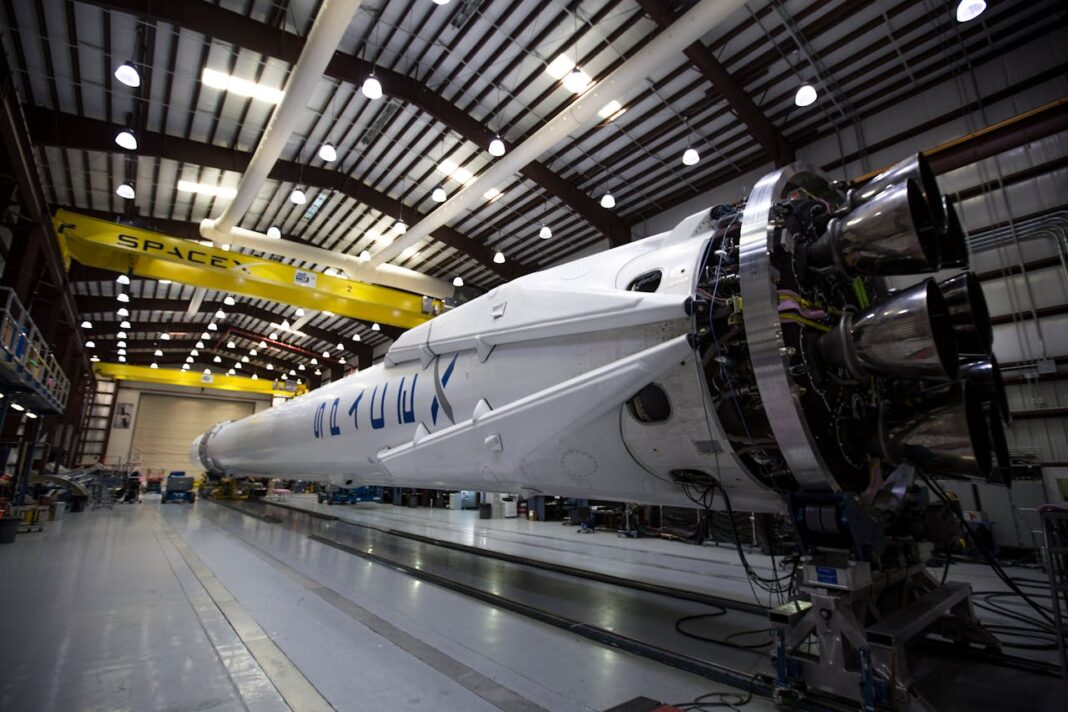

The potential SpaceX IPO could become one of the most important events in the history of the public space market. For years, investors interested in the space economy have had to look for “second-best” opportunities – companies such as Rocket Lab, Redwire, or Intuitive Machines – because the undisputed leader of the sector remained private. If SpaceX finally enters the stock market, this could radically change how Wall Street values the entire space industry.
At first glance, a SpaceX listing may look like bad news for smaller space stocks. Investors could simply sell companies like Redwire, Rocket Lab, or LUNR and move their capital into the strongest and most recognizable player in the sector. But the situation may be more complex. A successful SpaceX IPO could also validate the space economy as a serious investment theme, attract new capital to the sector, and force analysts to reprice smaller companies that operate in adjacent areas: launch services, lunar infrastructure, space manufacturing, satellite components, and defense-related space systems.
In other words, the SpaceX IPO may not only be about SpaceX. It could become a benchmark moment for the entire public space market – a catalyst that separates real space infrastructure companies from speculative names, while giving investors a clearer framework for comparing Rocket Lab, Redwire, Intuitive Machines, and other emerging players. The key question is whether SpaceX will absorb all the attention, or whether its debut will create a broader “halo effect” for the next generation of space stocks.
The “Rising Tide Lifts All Boats” Effect
A SpaceX IPO would not be just another stock market debut. It could become a historic validation moment for the entire space economy. SpaceX is not a niche space startup – it is the company that reshaped the launch market, built the world’s most important reusable rocket system, created Starlink, and became a strategic partner for NASA, the U.S. government, and the global satellite industry.
If SpaceX goes public at a massive valuation and demand for its shares is strong, Wall Street may be forced to look at the whole space sector differently.
The key impact would come from three areas:
- Sector validation
For years, many institutional investors treated public space stocks as speculative names with distant promises and uncertain business models. A successful SpaceX IPO would show that space is no longer only a “future trend” – it is a real industrial market with revenue, contracts, infrastructure, and strategic importance. - New valuation benchmark
SpaceX would likely become the reference point for valuing other space companies. Investors would start comparing smaller players to SpaceX in terms of backlog, revenue growth, government contracts, launch capability, manufacturing capacity, and long-term market potential. - Capital rotation into alternatives
Not every investor will be able to buy SpaceX at an attractive price. Some funds may receive limited IPO allocation. Others may decide that SpaceX is too expensive after the listing. That could push capital toward smaller, publicly traded space companies with higher upside potential.
This is where companies like Rocket Lab, Redwire, and Intuitive Machines could benefit directly.
- Rocket Lab ($RKLB) could be seen as the closest public alternative to SpaceX, especially because it combines launch services, spacecraft manufacturing, and government contracts.
- Redwire ($RDW) could attract investors looking for exposure to space infrastructure, satellite components, microgravity manufacturing, and defense-related systems.
- Intuitive Machines ($LUNR) could become one of the clearest public plays on lunar infrastructure, NASA contracts, and the future Moon economy.
In simple terms: SpaceX may become the “blue chip” of the space sector, but smaller companies could become the high-upside trades around the same theme. If investors start asking, “What is the next best public space stock after SpaceX?”, Rocket Lab, Redwire, and LUNR may move from niche space names to mainstream investment candidates.
Case-by-case analysis: How each stock could benefit
If the SpaceX IPO materializes at the scale currently discussed by Reuters – with a potential Nasdaq listing and a valuation that could make it the biggest stock market flotation of all time – the impact would not be distributed equally across the sector. Different public space companies would benefit for different reasons: some as competitors, some as suppliers, and some as infrastructure plays tied to the next phase of space commercialization.
Rocket Lab ($RKLB) – The main “anti-SpaceX” trade
Rocket Lab is probably the most obvious public-market alternative to SpaceX. It is not SpaceX at a smaller scale, but it gives investors exposure to a similar investment theme: launch, spacecraft manufacturing, satellite components, and government demand for space access.
The strongest argument for Rocket Lab is simple: customers do not want a launch monopoly.
That applies especially to:
- government agencies, including defense and national security customers;
- satellite operators, which need reliable launch schedules;
- commercial space companies, which do not want to depend on one provider;
- strategic buyers, who may want a non-SpaceX option for political, operational, or supply-chain reasons.
Rocket Lab already operates Electron, a dedicated small-launch vehicle, and is developing Neutron, a larger launch vehicle designed to serve commercial and government missions. The company also emphasizes vertical integration across spacecraft, subsystems, software, launch logistics, and satellite components.
This matters because after a SpaceX IPO, investors may start asking a very direct question:
“If SpaceX is worth this much, what is the best public alternative?”
For many investors, the answer may be Rocket Lab.
Key potential benefits for RKLB:
- Launch scarcity premium – if demand for launch capacity keeps growing, any credible non-SpaceX launch provider becomes more valuable.
- Neutron optionality – successful development of Neutron could move Rocket Lab from small-launch specialist to a more serious medium-lift competitor.
- Space systems re-rating – Rocket Lab is not only a rocket company. Its spacecraft and components business could receive a higher valuation multiple if SpaceX lifts the perceived value of integrated space companies.
- Institutional capital rotation – funds priced out of SpaceX may look for a listed company with a similar “space infrastructure” story.
In this scenario, Rocket Lab becomes the cleanest “anti-SpaceX” public trade: not because it can beat SpaceX directly, but because the market may reward the only listed company that offers a credible mix of launch capability, manufacturing, and space systems exposure.
Redwire Space ($RDW) – The supplier and infrastructure winner
Redwire is a different type of space stock. It is not trying to compete with SpaceX in launch. Instead, it builds the infrastructure that space companies need once access to orbit becomes cheaper and more frequent.
That distinction is important. For Redwire, a successful SpaceX IPO could be bullish not because SpaceX is a competitor, but because SpaceX makes the entire space economy bigger.
Redwire’s business includes technologies such as:
- Roll-Out Solar Arrays, known as ROSA;
- power systems and deployable structures;
- satellite payloads and avionics;
- robotic systems;
- microgravity research and manufacturing;
- in-space 3D printing and manufacturing capabilities.
The investment thesis here is very direct:
More rockets = more satellites. More satellites = more demand for components, power systems, structures, and space infrastructure.
If SpaceX continues to lower the cost of reaching orbit through Falcon and Starship, more companies may be able to build constellations, deploy payloads, run experiments, and develop commercial space stations. That would create a larger addressable market for companies like Redwire.
Key potential benefits for RDW:
- Supplier leverage – Redwire can benefit from growth across the whole space ecosystem, not only from one launch provider.
- Lower launch costs – cheaper access to orbit improves the business case for more satellites, more platforms, and more in-space manufacturing.
- Space infrastructure narrative – investors may start valuing Redwire less like a speculative small-cap and more like an industrial supplier to the orbital economy.
- Potential SpaceX-adjacent demand – if mega-constellations, commercial stations, lunar infrastructure, and satellite platforms expand, Redwire could become part of the supply chain.
The key difference is that Redwire does not need to be the next SpaceX. Its bull case is simpler: if SpaceX accelerates the space economy, Redwire sells the picks and shovels.
Intuitive Machines ($LUNR) – The lunar logistics play
Intuitive Machines is the most direct public bet on the Moon economy. The company is tied to NASA’s Artemis ecosystem, Commercial Lunar Payload Services, lunar deliveries, and the broader idea that the Moon will become a commercial and strategic destination.
NASA’s CLPS program is designed to create rapid, frequent, and more affordable access to the lunar surface, and Intuitive Machines has been one of the key commercial providers in that program. NASA awarded the company a $180.4 million CLPS contract in 2026 to deliver science and technology payloads to the lunar surface.
This is where the SpaceX connection becomes important.
NASA’s Artemis architecture depends heavily on SpaceX’s Starship Human Landing System for future crewed lunar missions, including Artemis III and Artemis IV. If a SpaceX IPO gives the company even more capital, visibility, and market pressure to complete Starship milestones, the entire lunar infrastructure timeline could become more credible.
That could benefit LUNR in several ways:
- Faster Artemis momentum – if Starship HLS progresses, NASA’s broader lunar roadmap becomes more investable.
- More lunar deliveries – regular lunar missions create demand for payload delivery, surface operations, communications, navigation, and logistics.
- Commercial Moon economy narrative – Intuitive Machines could be viewed not just as a lander company, but as a logistics and infrastructure company for the lunar market.
- Lower launch costs – cheaper access to orbit and cislunar space could improve the economics of commercial Moon missions.
The simple version:
SpaceX may build the highway to the Moon. Intuitive Machines could become one of the companies delivering cargo, tools, data, and infrastructure once that highway exists.
That makes LUNR a higher-risk but potentially higher-upside beneficiary of the SpaceX IPO narrative. Unlike Rocket Lab, it is not an “anti-SpaceX” trade. Unlike Redwire, it is not mainly a supplier. It is a bet on the idea that SpaceX and NASA will make lunar infrastructure real – and that Intuitive Machines will be one of the companies operating inside that new market.
Key market mechanisms: What would actually change after a SpaceX IPO?
The biggest change would not be only emotional. It would be financial.
As a private company, SpaceX can control how much information the market sees. Investors hear about revenue, Starlink growth, launch cadence, Starship progress, and government contracts mainly through selective reports, leaks, secondary-market transactions, and media coverage. But once SpaceX becomes a public company, that changes. U.S. public companies must publish regular financial disclosures, including annual 10-K reports, quarterly 10-Q reports, and current 8-K reports for major events. These filings would give investors a much clearer view of SpaceX’s revenue, margins, cash flow, debt, capex, and profitability.
That transparency could become extremely important for the rest of the space sector.
Why? Because analysts would finally have a real benchmark.
If SpaceX reports strong profitability, high operating leverage, and fast revenue growth, it would help prove that space is not only a capital-intensive dream, but a scalable business model. That would make it easier to value companies like Rocket Lab, Redwire, and Intuitive Machines using peer valuation – comparing revenue growth, backlog, gross margins, contracts, and future market potential against the sector leader.
The second mechanism is valuation multiples.
If SpaceX debuts with a very high P/S ratio or even a premium P/E ratio, the market may suddenly look at smaller space stocks differently. Today, many of these companies trade with a heavy “execution risk discount.” Investors worry about delayed missions, cash burn, technical failures, and uncertain profitability. But if SpaceX receives a massive premium, the question becomes obvious:
If SpaceX deserves a huge multiple, are Rocket Lab, Redwire, and LUNR actually undervalued relative to the opportunity?
That does not mean all smaller space stocks should automatically rise. But it may create a powerful re-rating setup. Rocket Lab could be valued more like a strategic launch and spacecraft platform. Redwire could be valued more like a critical infrastructure supplier. Intuitive Machines could be valued more like a lunar logistics company, not just a risky NASA contractor.
In other words, SpaceX could give Wall Street the missing reference point.
The other side of the coin: Risks and threats
The bullish case is strong, but it is not risk-free. A SpaceX IPO could also hurt smaller space stocks, at least in the short term.
The first risk is liquidity drain.
If the SpaceX IPO becomes the most attractive public-market event in years, some investors may sell shares of Rocket Lab, Redwire, Intuitive Machines, Planet Labs, or other space stocks simply to free up cash. In that scenario, the first reaction could be negative for the sector. SpaceX would attract attention, capital, and media coverage, while smaller names could temporarily become funding sources for investors trying to buy the leader.
The second risk is valuation compression.
Once SpaceX becomes public, investors will be able to compare smaller companies against the strongest player in the market. That could help some stocks, but it could also expose weaknesses. If SpaceX shows better margins, stronger growth, lower launch costs, and larger scale, the market may become more selective. Companies without clear revenue growth, strong backlog, or a credible path to profitability may be punished.
The third risk is price pressure.
SpaceX has already changed the economics of launch. After an IPO, with even greater access to capital, it could become more aggressive. If SpaceX lowers prices, accelerates Starship development, or expands into more segments of the space value chain, competitors may feel pressure on margins. Rocket Lab, especially in the medium-launch market with Neutron, could face a difficult balance: competing with SpaceX while trying to prove that customers will pay for launch diversity, reliability, and strategic independence.
So the SpaceX IPO is not a guaranteed win for every public space stock. It will likely separate stronger companies from weaker ones.
Final takeaway: SpaceX will not kill smaller space stocks
The most important conclusion is this: a SpaceX IPO would probably not kill Rocket Lab, Redwire, or Intuitive Machines. It may actually create a more mature ecosystem around them.
SpaceX is building the highways of the space economy: reusable rockets, Starship, Starlink, orbital infrastructure, and potentially the transport system that makes large-scale space commercialization possible.
But highways alone are not the whole economy.
Someone still has to build the vehicles, components, power systems, stations, logistics networks, payloads, lunar services, robotic tools, and commercial applications that use those highways. That is where companies like Rocket Lab, Redwire, and LUNR may find their place.
A good analogy would be the early software and internet markets. Microsoft did not eliminate every smaller technology company. Its success helped prove that software could become a massive industry. Amazon did not destroy every e-commerce or cloud company. It showed investors how large the market could become. Nvidia did not make every AI stock irrelevant. It created a benchmark that forced investors to look for the next layer of beneficiaries.
SpaceX could do something similar for space.
The IPO may make SpaceX the blue chip of the space economy. But for investors looking for higher-risk, higher-upside opportunities, the more interesting question may come next:
Which public companies become the suppliers, partners, and infrastructure builders of the SpaceX era?
If the market starts asking that question seriously, Rocket Lab, Redwire, and Intuitive Machines may no longer be treated as speculative space stories. They may become part of a much larger investment theme: the industrialization of space.