
Intuitive Machines (Nasdaq: LUNR) just dropped two major pieces of news simultaneously: record Q1 2026 results and a definitive agreement to acquire Goonhilly Earth Station Ltd — the UK’s premier deep space communications provider — along with its US subsidiary COMSAT. The market reacted immediately, with LUNR surging +11.19% on volume 1.3x above its 20-day average, bringing the stock to within 3% of its 52-week high.
But is this just a one-day pop — or something more structural? Here’s why this deal could fundamentally reshape what Intuitive Machines is worth.
What’s Actually Being Acquired
The deal, valued at £37 million (split equally between cash and 960,649 Class A shares, plus a £592,621.50 escrow), covers three divisions of the Goonhilly Group:
- Lunar and Deep Space Communications — including the GHY6 (32-meter) and the cryogenically cooled GHY3 (30-meter) antennas, with multiband support across X-band, S-band, and Ka-/Ku-band
- Commercial Satcom (via COMSAT)
- Defense and Security
In total, LUNR gains 44 antennas and operational sites in both the UK and the US. The transaction is expected to close in Q3 2026, pending UK National Security and Investment Act 2021 clearance and US FCC approval.
Why This Is Strategically Significant
1. Completing the Vertical Stack
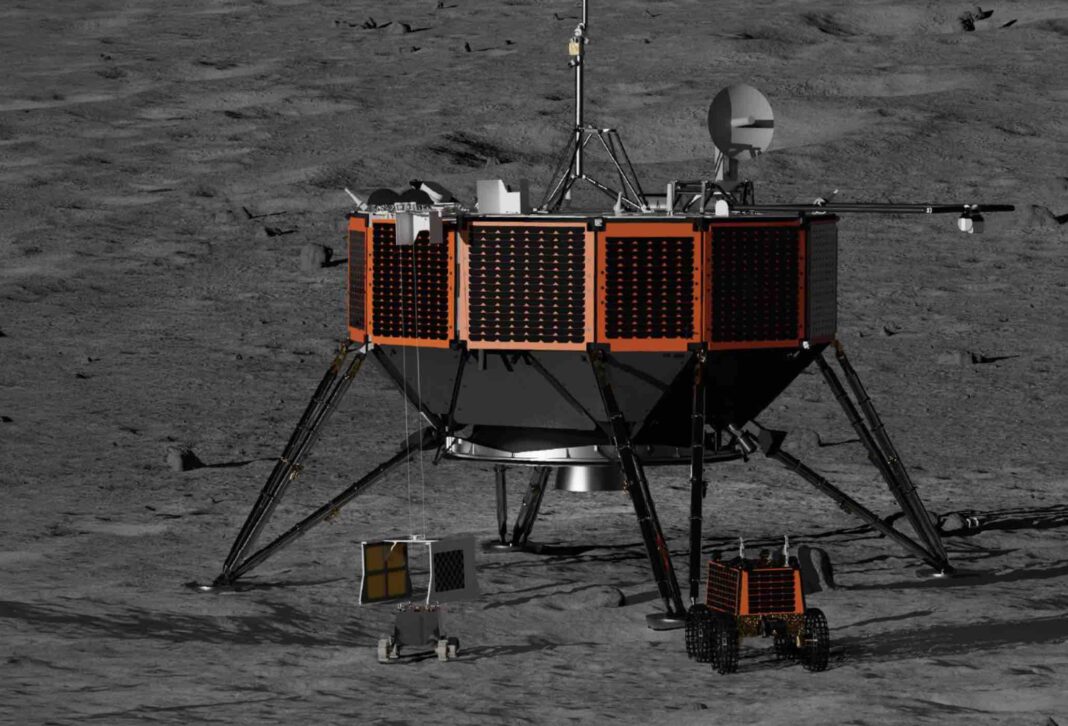
Intuitive Machines has been quietly executing a vertical integration playbook. The company already builds lunar landers (Nova-C, Nova-D class), operates payload delivery missions under NASA’s CLPS program, and provides precision navigation. What it lacked was a robust, owned ground segment to close the loop on the full communications chain.
Goonhilly fills that gap. Combined with the $800 million Lanteris acquisition completed in January 2026, LUNR now controls the full stack: spacecraft → launch integration → lunar surface delivery → data relay → ground reception. That’s a significant moat.
2. From “Rocket Company” to Infrastructure Operator
This is the more important narrative shift. LUNR is positioning itself not as a launch provider competing on cost-per-kg, but as the AWS of lunar infrastructure — a single, integrated operator that customers pay to access as a service.
CEO Steve Altemus was explicit: “Customers have been clear that they want a single, integrated, and resilient solution.” Every acquisition LUNR has made in the past 12 months reinforces this thesis. Goonhilly is not just hardware — it brings existing civil, commercial, and government customers, deep antenna expertise, and a UK regulatory footprint that opens European institutional contracts (ESA is already a client).
3. The UK Location Is Underrated
The geographic angle matters more than it appears. The Goonhilly site in Cornwall, UK provides different Earth-viewing arcs compared to US-based stations. For lunar and deep-space missions, having geographically distributed ground stations dramatically increases contact windows — the amount of time a spacecraft can be in communication with Earth. This is critical for real-time mission control, data downlink, and navigation corrections. More contact time = higher data throughput = more value per mission.
4. Defense & Security Revenue Diversity
Goonhilly’s Defense and Security division and COMSAT’s commercial satcom services add recurring revenue streams that are less lumpy than mission-by-mission contracts. This matters for a company trying to stabilize its revenue profile as it scales toward $900M–$1B in 2026 guidance.
The Financial Picture
The Q1 2026 numbers released alongside this announcement are striking on their own:
| Metric | Q1 2026 | Change YoY |
|---|---|---|
| Revenue | $186.7M | ~3x prior year |
| Adj. EBITDA | +$2.7M | First positive quarter |
| Contracted Backlog | $1.055B | +$842.4M vs. Dec 2025 |
The Lanteris acquisition contributed $612.8M of that backlog increase, with new awards adding another $428.9M. Management reiterated full-year 2026 guidance of $900M–$1B revenue with positive adjusted EBITDA.
Goonhilly at £37M is — relative to this scale — a small price for a strategically critical piece of infrastructure. For context, a single major NASA CLPS task order can be worth hundreds of millions. Buying a world-class deep space communications network for less than one task order is, if the integration goes well, an exceptional deal.
The Risks
No acquisition analysis is complete without the downside case:
- Integration complexity: LUNR is simultaneously digesting Lanteris ($800M), Goonhilly, and COMSAT. Running three integrations in parallel is operationally demanding.
- Regulatory risk: Both UK (NSI Act 2021) and US (FCC) approvals are required. Either could delay or block the transaction.
- Execution risk on guidance: The $900M–$1B revenue target depends heavily on continued NASA and defense contract execution. Any mission delay or contract dispute compresses the margin cushion.
- Debt load: The Lanteris acquisition was $800M — the balance sheet implications of that deal remain a key variable.
Bottom Line
Intuitive Machines is making a coherent, aggressive bet: that the coming decade of lunar exploration — Artemis, international partnerships, commercial lunar economy — requires persistent, reliable, end-to-end communications infrastructure, and that whoever owns that infrastructure will sit at the center of every mission.
Goonhilly Earth Station is a foundational piece of that bet. At £37M, it looks asymmetrically cheap relative to what it enables. The market seems to agree — at least for today.
The real test is whether LUNR can execute on integration, hit its 2026 guidance, and close this transaction without regulatory friction. If it does, the company that lands payloads on the Moon and talks to spacecraft across the solar system may end up being one of the defining infrastructure plays of the space age.
Sources: Intuitive Machines press release (May 14, 2026), SEC Form 8-K filing, StockTitan, TipRanks, Investing.com