

For decades, the idea of manufacturing drugs in space sounded like science fiction. Today, it is slowly becoming one of the most intriguing niches in the space economy. The reason is simple: microgravity changes the way molecules behave. In orbit, without the same convection, sedimentation and gravitational interference we see on Earth, pharmaceutical crystals can form in a more uniform and potentially higher-quality way. That could open the door to better drug formulations, improved stability, new delivery methods and even the revival of compounds that were previously difficult to manufacture on Earth.
This does not mean that companies will soon be producing billions of tablets in orbit. The real opportunity is more subtle — and potentially much more profitable. Instead of mass-producing medicine in space, companies may use space as a high-value research and manufacturing environment for seed crystals, drug formulations and advanced biologics that can later be scaled on Earth. Redwire has already been developing pharmaceutical crystallization platforms such as PIL-BOX, while private players like Varda Space Industries are building autonomous orbital manufacturing and reentry systems focused on pharmaceuticals.
For investors, this creates a new question: is “space pharma” just another speculative narrative, or could it become one of the first truly commercial use cases for low Earth orbit? The answer depends on execution, partnerships with major pharmaceutical companies, regulatory progress, return-to-Earth logistics and whether public companies can turn early experiments into repeatable revenue. In this article, we will look at how drugs in space actually work, why microgravity matters, which companies are leading the race, and which stocks may offer exposure to this emerging market.
What kind of market is this – and will it grow?
The market for pharmaceuticals in microgravity is moving from an experimental NASA-led niche into a real commercial sector. For years, drug research in space was mostly associated with academic projects, protein crystallization experiments and scientific curiosity. Today, the narrative is changing: companies are beginning to treat microgravity as a manufacturing advantage, not just a research environment. The key idea is that certain molecules, crystals and biologics may behave differently in orbit, potentially allowing for better purity, improved stability or new formulations that are difficult to achieve on Earth.
Market estimates vary, but the direction is clearly positive. One recent market report values the global pharmaceuticals in microgravity market at around $3.8 billion in 2025, with a forecast of roughly $10.6 billion by 2034, implying a CAGR of about 12.1%. Broader estimates for the whole in-space manufacturing sector are even more aggressive: some forecasts suggest growth from around $6.1–6.3 billion in 2025 to nearly $38–39 billion by 2035, with CAGR around 20%.
Why is this accelerating now? The answer is a combination of lower launch costs, reusable rockets, commercial space stations and regulatory progress. SpaceX and other launch providers have made access to orbit more repeatable, while private companies are preparing platforms that could eventually replace or complement the ISS. At the same time, regulators are starting to think seriously about how “space-made” drugs could be approved for use on Earth. In the UK, the MHRA, UK Space Agency, Regulatory Innovation Office and Civil Aviation Authority have already announced cooperation on guidance, regulatory sandboxes and case studies for space-based pharmaceutical manufacturing.
Key numbers worth watching:
- $3.8B – estimated value of the global pharmaceuticals-in-microgravity market in 2025.
- $10.6B – projected market size by 2034.
- ~12.1% CAGR – expected annual growth rate for pharmaceuticals in microgravity.
- $6.1–6.3B – estimated size of the broader in-space manufacturing market in 2025.
- $37.7–39.2B – projected size of the in-space manufacturing market by 2035.
- ~20% CAGR – expected growth rate for the broader orbital manufacturing sector.
- Main growth drivers: reusable rockets, falling launch costs, commercial space stations, autonomous return capsules, pharma partnerships and emerging regulatory pathways.
Which companies are worth watching? A category-based approach
Investors can approach the drugs-in-space trend in three different ways. The first and arguably safest route is to invest in companies that provide the infrastructure: the hardware, laboratories, return vehicles, robotic systems and orbital platforms needed to make pharmaceutical research in microgravity possible. This is the classic “picks and shovels” strategy. Instead of betting on one specific drug or one biotech breakthrough, investors buy exposure to the companies that could support the whole industry.
A. Infrastructure and hardware companies – the safer “tools provider” bet
Redwire Corporation (RDW) is probably the clearest public-market name in this category. The company is not just talking about space-based biotech – it already has working platforms in orbit. Redwire has developed technologies such as PIL-BOX, a pharmaceutical crystal-growth platform designed for microgravity, and the BioFabrication Facility, which has been used for bioprinting live human tissue in space. Importantly, Redwire has also worked with Eli Lilly on spaceflight investigations related to pharmaceutical crystallization, which gives the company credibility beyond the typical “space startup” narrative.
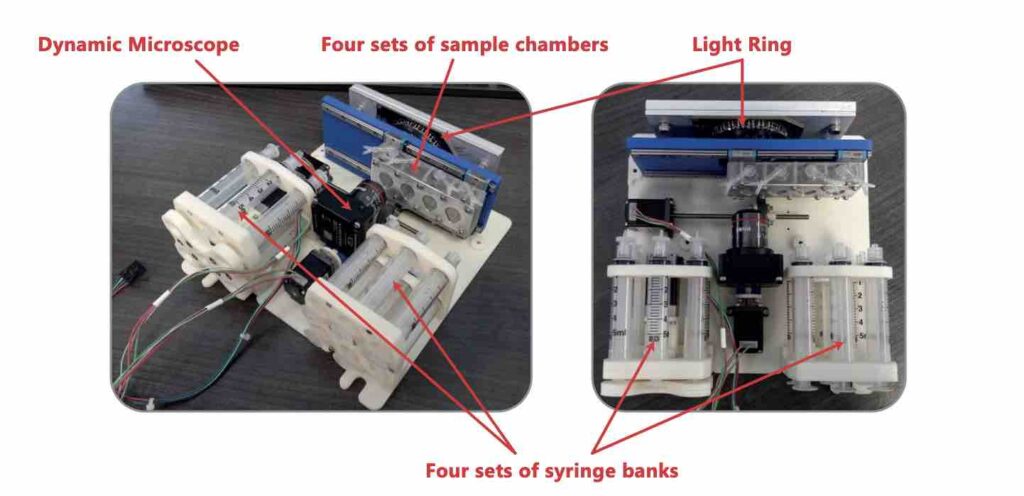
From an investor’s perspective, Redwire is interesting because it does not need to become a pharmaceutical company itself. Its role is closer to a space-based laboratory supplier. If microgravity drug research becomes a serious market, pharma companies may need exactly the kind of hardware, payload systems and orbital infrastructure that Redwire is building. In other words, Redwire could benefit no matter which specific drug candidate or biotech partner ultimately wins.
Key reasons why RDW may be worth watching:
- Direct exposure to microgravity pharma and biotech through PIL-BOX and tissue-printing platforms.
- Existing spaceflight heritage, not just concepts or early-stage prototypes.
- Partnerships with major pharma players, including Eli Lilly.
- Broader space infrastructure business, which may reduce reliance on one single market.
- “Picks and shovels” profile – Redwire sells the tools needed for the industry to develop.
Intuitive Machines (LUNR) is a different type of opportunity. The company is best known for its lunar missions, but its potential role in the space-pharma economy is more about logistics, navigation, orbital mobility and return-to-Earth capability. For pharmaceuticals made or tested in orbit, the product eventually needs to come back to Earth safely, quickly and under controlled conditions. That is where reentry vehicles and space logistics become extremely important.

Intuitive Machines has been selected by the Texas Space Commission to advance an Earth reentry and microgravity biomanufacturing spacecraft, and the company has also discussed an Earth reentry vehicle capable of supporting missions returning from low Earth orbit, the Moon or Mars. Its Orbital Transfer Vehicle work also fits into a broader strategy of building mobility infrastructure for the Earth-Moon economy.
For investors, LUNR is not a pure space-pharma play in the same way Redwire is. It is more of a space logistics and infrastructure bet. If orbital manufacturing grows, companies will need reliable transportation, return capsules, communications, mission operations and recovery systems. Intuitive Machines could become one of the companies enabling that supply chain.
Key reasons why LUNR may be worth watching:
- Exposure to space logistics, not only lunar landers.
- Potential role in returning space-manufactured materials to Earth.
- Government-backed development programs related to reentry and microgravity biomanufacturing.
- Broader infrastructure position in the Earth-Moon economy.
- Higher-risk, higher-upside profile compared with more diversified infrastructure companies.
In simple terms: Redwire looks like the more direct play on “drugs in space,” while Intuitive Machines looks like a logistics and return-infrastructure play. RDW may benefit if pharma companies need orbital labs and microgravity equipment. LUNR may benefit if the industry needs reliable ways to move materials between Earth, orbit and eventually the Moon. Neither stock is risk-free, but both give public-market investors a clearer route into the emerging space-pharma supply chain than trying to pick a single future “space-made drug” winner.
B. Logistics and “space factories” – the highest hype potential
The second category is more speculative, but probably the most exciting from a market-narrative perspective: companies that want to build actual space factories. Here, the key name is Varda Space Industries. Varda is still private, so investors cannot simply buy the stock on a public exchange today, but it is one of the most important companies to watch if the “drugs in space” theme ever becomes a mainstream investment trend. The company is building autonomous W-Series spacecraft designed to process high-value materials in orbit and return them to Earth inside a reentry capsule. In simple terms: launch a small factory, manufacture or process a pharmaceutical ingredient in microgravity, bring the capsule back, analyze the material on Earth and then use the result for commercial development.

Varda has already shown that this is more than a PowerPoint idea. Its W-1 mission grew crystals of Form III ritonavir, an antiretroviral drug used in HIV treatment, and the capsule returned to Earth at the Utah Test and Training Range in February 2024. According to Varda, W-1 was also the first commercial spacecraft to land on a military test range and the first spacecraft approved to reenter under the FAA’s Part 450 license. That matters because space manufacturing is not only about producing something in orbit – it is also about proving that you can bring it back safely, repeatedly and legally.
The company has since moved from a one-off demonstration toward a higher mission cadence. Varda’s W-5 mission reentered in January 2026 and debuted the company’s vertically integrated next-generation satellite bus, while W-6 launched in March 2026 as the company’s sixth mission overall and its first launch of 2026. This is important for investors because the market will not reward “space pharma” only for scientific breakthroughs. It will reward repeatability: frequent launches, reliable reentries, lower costs, more customer payloads and a clearer path from experiment to revenue.
For now, Varda is mainly a company to track before a potential IPO. If it eventually goes public, it could attract significant hype because it sits at the intersection of three powerful narratives: space infrastructure, pharmaceutical innovation and autonomous manufacturing. However, the risk would also be high. Investors would need to understand whether Varda is really becoming a scalable manufacturing platform or whether it remains a high-cost experimental service for a narrow group of customers.
Key reasons why Varda may become one of the most watched space-pharma companies:
- Pure-play exposure to orbital pharmaceutical processing.
- Autonomous capsule model, independent from traditional space stations.
- Successful ritonavir crystallization experiment in orbit.
- Proven reentry and recovery capability, which is essential for drug development.
- Growing mission cadence, with multiple W-Series missions already launched or returned.
- Potential IPO candidate, although still private today.
A public-market alternative to watch in this category is Rocket Lab (RKLB). Rocket Lab is not a space-pharma company, but it has provided Pioneer spacecraft for Varda missions, which makes it an indirect infrastructure supplier to the orbital manufacturing trend. Rocket Lab stated that it produced three Pioneer spacecraft for Varda, integrating them with Varda’s W-Series capsules to support pharmaceutical processing in orbit and return to Earth. That means RKLB can be viewed as a “logistics and spacecraft supplier” angle rather than a direct bet on space-made drugs.
C. Big Pharma – the final beneficiaries
The third category is Big Pharma: companies such as Eli Lilly (LLY), Merck (MRK) and Bristol Myers Squibb (BMY). This is the most conservative way to approach the theme, but also the least direct. These companies are not space stocks. Their share prices will still be driven mainly by drug pipelines, patent cliffs, clinical trials, pricing pressure, obesity drugs, oncology franchises and global pharma regulation. But if microgravity helps them create better formulations of blockbuster drugs, the financial impact could be enormous.
Merck is the best example of why this matters. Its cancer drug Keytruda was studied in microgravity through crystallization experiments on the International Space Station. NASA later noted that ISS research helped provide early insights into particle structure and size relevant to the development of a subcutaneous formulation of pembrolizumab. In September 2025, the FDA approved Keytruda Qlex, a subcutaneous version of pembrolizumab with berahyaluronidase alfa-pmph, for solid tumor indications already approved for intravenous Keytruda. This does not mean the final product was “manufactured in space,” but it shows how space-based research can influence real-world drug formulation strategy.
For Merck, the stakes are huge because Keytruda is one of the most important drugs in the world. Merck reported $31.7 billion in 2025 sales for Keytruda/Keytruda Qlex. So even small improvements in delivery, patient convenience, treatment time or lifecycle management can matter financially. This is the real Big Pharma opportunity: not necessarily selling “space-made medicine” as a separate category, but using microgravity research to improve or extend the value of existing blockbuster therapies.
Eli Lilly is also worth watching because it has already partnered with Redwire on PIL-BOX missions. Redwire announced that Lilly participated in PIL-BOX research focused on treatments for diabetes, cardiovascular disease and pain. For Lilly, the space-pharma angle is small compared with its massive obesity and diabetes business, but that is exactly why it is interesting: if microgravity research helps improve formulation, stability, delivery or manufacturing of high-value biologics and metabolic drugs, the commercial upside could be meaningful even if the space experiment itself looks tiny.
Bristol Myers Squibb has also explored microgravity crystallization. The company has described experiments involving biologics medicines crystallized on the International Space Station and has argued that protein crystallization could eventually change how biologics are developed, manufactured and stored. Again, this is not a pure investment thesis on its own, but it shows that major pharmaceutical companies are treating space research as a serious R&D tool rather than a publicity stunt.
For investors, Big Pharma is the “safer but diluted” approach. Buying LLY, MRK or BMY gives exposure to companies that could benefit from microgravity breakthroughs, but space research will remain only a small part of the overall investment case. These stocks are not likely to double just because of one successful space experiment. However, if space-based crystallization helps improve the delivery of a multi-billion-dollar cancer, diabetes or obesity drug, the impact could appear indirectly through stronger product lifecycles, better patient adoption and more defensible intellectual property.
Key reasons why Big Pharma matters in the space-drugs theme:
- They own the blockbuster molecules that could benefit from better formulations.
- They can fund orbital research without depending on speculative capital markets.
- They already understand regulation, clinical trials and commercialization.
- They can turn a small scientific improvement into a major financial advantage.
- Their risk is lower, but the space-pharma upside is diluted inside much larger businesses.
In short: Varda offers the most exciting “space factory” narrative, but it is still private. Rocket Lab offers indirect public exposure to the logistics side. Big Pharma offers the most realistic path to commercial impact, but with much less pure-play exposure. For investors, the best approach may be to treat this market as a layered supply chain: Redwire builds the tools, Varda proves the factory model, Rocket Lab supports the logistics, and companies like Merck, Lilly and Bristol Myers Squibb may ultimately capture the largest value if space research leads to better drugs.
Near-term future and key risks – a balanced view
The next phase of the drugs-in-space market will likely be shaped by private space infrastructure. As the ISS moves toward retirement, companies such as Axiom Space and Vast, with its planned Haven-1 station, are positioning themselves as commercial successors for low-Earth-orbit research. Vast describes Haven-1 Lab as a commercial microgravity research, development and manufacturing platform, with applications in pharmaceuticals, biotech, regenerative medicine and advanced materials.
This matters because pharmaceutical companies need more than one-off experiments. To turn microgravity drug research into a real industry, they need dedicated labs, predictable launch schedules, repeatable reentry options, regulatory clarity and reliable partners. The UK has already taken an important step in this direction: in March 2026, the UK government announced work on regulatory guidance, case studies, a re-entry regulatory sandbox and supply-chain engagement for space-manufactured medicines.
Still, this is not a risk-free story. The biggest opportunity is clear: space could help pharma companies create better crystals, improved biologics and new drug formulations. But the biggest risks are also obvious. A failed launch or failed reentry could destroy an extremely expensive payload. R&D costs remain high. The business model is still early. And legal questions around patents, manufacturing jurisdiction and ownership of space-generated intellectual property are not fully solved.
Opportunities:
- Private space stations such as Axiom Station and Haven-1 may replace part of the research role currently played by the ISS.
- Dedicated orbital laboratories could make microgravity pharma more repeatable and commercially scalable.
- Regulatory progress may reduce uncertainty, especially if the UK’s 2026 framework becomes a model for other countries.
- Big Pharma interest gives the sector credibility because companies like Merck, Eli Lilly and Bristol Myers Squibb can fund research and commercialize results.
- Lower launch costs and reusable rockets make frequent experimentation more realistic than in the past.
Risks:
- Launch or reentry failure could mean losing a high-value pharmaceutical payload.
- High upfront R&D costs may delay profitability for smaller space companies.
- Unclear patent law in space could create disputes over ownership, jurisdiction and commercialization rights.
- Regulatory uncertainty remains a major issue, especially for drugs manufactured or modified outside Earth.
- Hype risk is real: some companies may benefit from the “space pharma” narrative before proving a durable business model.
The balanced conclusion is this: space-made drugs are no longer science fiction, but they are not yet a mature investment category. The safest exposure may come from infrastructure providers such as Redwire, indirect logistics suppliers such as Rocket Lab or Intuitive Machines, and Big Pharma companies that can absorb the cost of experimentation. The highest upside may come from future pure-play space-factory companies like Varda, but that also means higher risk, more volatility and a much longer time horizon.
Sources:
- https://www.gov.uk/government/news/uk-sets-out-world-leading-pathway-for-space-manufactured-drugs
- https://www.gov.uk/government/news/joint-statement-from-the-uk-space-agency-the-medicines-and-healthcare-products-regulatory-agency-the-regulatory-innovation-office-and-the-civil-avia
- https://www.mdpi.com/2504-4494/9/3/84
- https://www.nsf.org/ca/en/life-science-regulatory-news/u-k-drug-manufacturing-in-space
- https://www.axiomspace.com/in-space-manufacturing
- https://rocketlabcorp.com/missions/launches/varda-space-industries/
- https://www.varda.com/mission/w-1
- https://www.varda.com/science/gravity-as-a-knob-for-tuning-particle-size-distributions-of-small-molecules