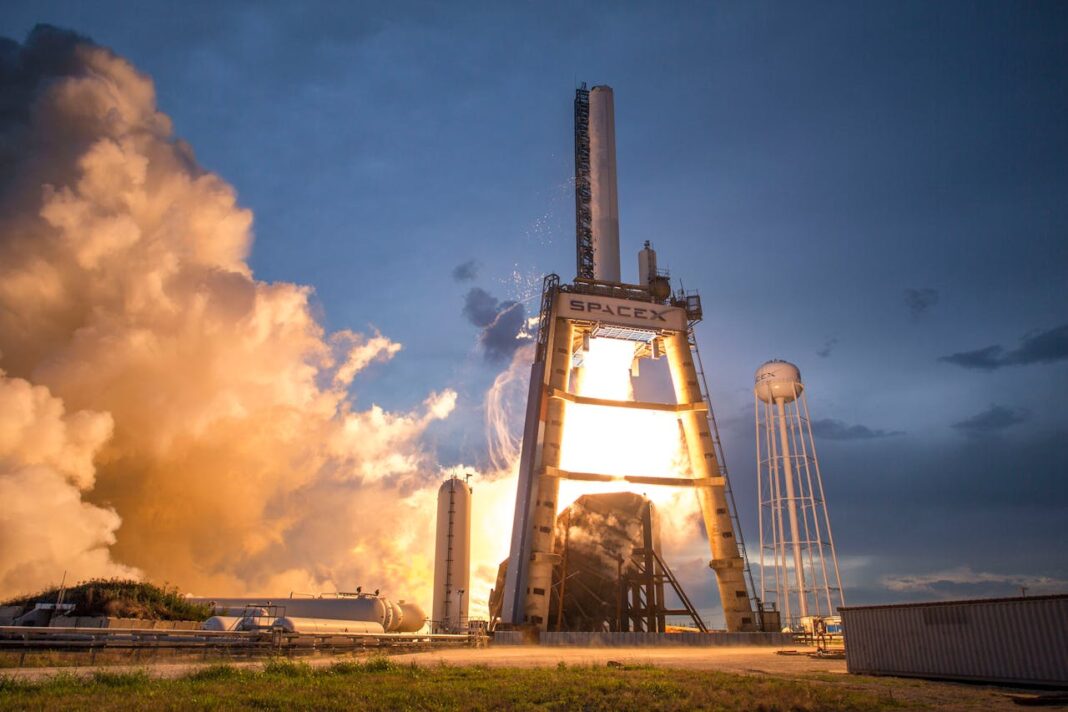

Space stocks are back in the spotlight. After years of volatility, dilution, delayed missions, and investor skepticism, the SpaceTech sector is once again attracting serious market attention. What changed? The answer is not one single event, but a powerful combination of catalysts: rising defense demand, NASA and commercial contracts, lunar infrastructure programs, satellite data monetization, AI-driven geospatial intelligence, and the growing possibility that private space leaders may soon reshape public market valuations.
For investors, this is no longer just a futuristic story about rockets and Mars. SpaceTech is becoming a real industrial ecosystem – one that connects national security, communications, Earth observation, logistics, artificial intelligence, and next-generation manufacturing. Companies that once traded mainly on hype are now being judged by backlog, revenue visibility, mission execution, and their ability to turn space infrastructure into scalable business models.
This momentum is especially important because the market may be entering a new phase. If large private players like SpaceX continue to expand or eventually enter public markets, the entire sector could benefit from fresh investor interest and new valuation benchmarks. At the same time, smaller public companies such as Rocket Lab, Intuitive Machines, Planet Labs, BlackSky, Redwire, and others are racing to prove that they are not just speculative space stocks, but essential players in the next wave of commercial and government space investment.
In this article, we look at the key catalysts sending space stocks into orbit – and why the current SpaceTech momentum may be more than just another short-term market trend.
The SpaceX IPO Effect and the Sector Re-rating
One of the biggest potential catalysts for the entire SpaceTech market is the long-discussed SpaceX IPO. If the company eventually enters the public market at a valuation above $1 trillion, it could become not only one of the largest IPOs in history, but also a turning point for how investors value the entire space economy.
Why does it matter?
- SpaceX would bring mainstream attention to SpaceTech
A public listing would attract large institutional investors, funds, ETFs, and analysts who previously treated the sector as too speculative. - The market would finally get a benchmark
As a public company, SpaceX would have to report quarterly results, margins, revenue growth, backlog, and profitability. That would give investors a clear reference point for valuing other space companies. - Smaller public space stocks could benefit from a re-rating
If SpaceX receives a premium valuation, investors may start asking whether other listed SpaceTech companies are still undervalued.
This could create what investors often call the “SpaceX adjacency trade.”
In simple terms: not everyone will be able or willing to buy SpaceX after IPO, especially if the valuation is extremely high. So investors may look for smaller, cheaper, publicly traded companies with exposure to the same long-term trend.
Potential beneficiaries include:
- Rocket Lab – as one of the most obvious public alternatives in launch services and space systems.
- Redwire – as a space infrastructure, robotics, and microgravity manufacturing play.
- Intuitive Machines – as a lunar infrastructure and NASA/defense contractor.
- Planet Labs – as a leader in Earth observation and satellite data.
- BlackSky – as a real-time geospatial intelligence company focused on government and defense demand.
The logic is straightforward: if SpaceX trades at a massive revenue or earnings multiple, the market may start to apply higher valuation expectations to the entire sector. Even companies that are not direct competitors could benefit, because they operate inside the same expanding space ecosystem.
However, this would not lift every company equally. The strongest upside would likely go to businesses with:
- real contracts and backlog,
- growing revenue,
- clear government or defense demand,
- proven mission execution,
- a credible path to profitability.
In other words, the SpaceX IPO could change the investor narrative from:
“Space stocks are speculative and risky”
to:
“Space is becoming a serious, investable industrial sector.”
That shift alone could bring fresh capital into the market and potentially push the strongest public SpaceTech names into a completely new valuation range.
War and Geopolitics: Space as a Defense Shield
Another major catalyst for SpaceTech stocks is the growing role of space in modern defense. Today, satellites are no longer just tools for communication or weather forecasting. They are becoming a critical layer of national security – used for missile detection, battlefield awareness, secure communications, navigation, intelligence, and real-time monitoring of enemy movements.
The key driver is simple: geopolitical tension is pushing governments to spend more on space-based defense systems.
This includes programs such as:
- Golden Dome in the United States – a proposed missile-defense architecture that could rely heavily on space-based sensors, tracking satellites, and potentially space-based interceptors. Recent estimates suggest the system could cost hundreds of billions of dollars, with some projections going above $1 trillion over time.
- Space Development Agency satellite constellations – focused on missile warning, missile tracking, and resilient military communications in low Earth orbit.
- European secure satellite programs, including GOVSATCOM and IRIS², designed to give Europe more resilient and sovereign satellite communication capabilities for government, security, and critical infrastructure users.
For investors, this changes the investment case for space companies. The sector is no longer driven only by commercial dreams like tourism, Mars missions, or broadband internet from orbit. Increasingly, the strongest demand comes from government and defense budgets – and those budgets tend to be large, long-term, and strategically protected.
Potential beneficiaries include companies exposed to:
- government satellite constellations,
- missile warning and tracking systems,
- space-based surveillance and reconnaissance,
- anti-jamming and secure communication systems,
- real-time geospatial intelligence,
- rapid launch and satellite replenishment capabilities.
This is why large defense contractors remain key winners. Lockheed Martin, Northrop Grumman, and L3Harris are already deeply involved in missile warning, satellite tracking, and military space architectures. For example, the U.S. Space Development Agency recently awarded contracts for 72 missile-warning and tracking satellites, with Lockheed Martin, Northrop Grumman, L3Harris, and Rocket Lab each selected to deliver 18 space vehicles.
But the opportunity does not stop with defense giants.
Smaller public SpaceTech companies can also benefit from this shift:
- Rocket Lab may gain from rising demand for responsive launch, satellite manufacturing, and defense-related space systems.
- Planet Labs can benefit from growing demand for satellite imagery used in intelligence, security, border monitoring, and conflict analysis. The company has already seen strong government-related demand, including a major satellite deal in Asia-Pacific tied to security and intelligence use cases.
- BlackSky is positioned around real-time geospatial intelligence, making it relevant for governments that need fast monitoring of military activity, infrastructure, ports, borders, and crisis zones.
- Redwire may benefit indirectly as defense and civil agencies demand more advanced space infrastructure, robotics, antennas, sensors, and in-orbit systems.
The investment logic is clear: if space becomes a permanent layer of national defense, then space companies become strategic infrastructure providers.
That can support higher valuations because these companies are not just selling technology. They are selling capabilities governments increasingly consider essential:
- seeing threats earlier,
- communicating securely,
- protecting satellites from disruption,
- tracking missiles and hypersonic weapons,
- replacing damaged or disabled assets quickly,
- maintaining intelligence advantage from orbit.
In this scenario, SpaceTech momentum is not just a market trend. It becomes part of a broader defense cycle. As wars, sanctions, cyberattacks, and great-power rivalry continue to shape global policy, space may become one of the most important frontiers of military spending – and that could send selected space stocks into a new phase of growth.
Artemis and the Rise of Lunar Infrastructure
The next major catalyst is the return of humans to the Moon. NASA’s Artemis program is no longer just a symbolic exploration story – it is becoming the foundation for a much larger lunar economy. Artemis II has already marked a key milestone as the first crewed Artemis flight, launching on April 1, 2026, and splashing down on April 10, 2026, after a crewed lunar flyby.
At the same time, China is accelerating its own lunar ambitions, targeting a crewed Moon landing before 2030 and laying the groundwork for the International Lunar Research Station. This turns the Moon into both a scientific objective and a geopolitical arena.
For investors, the narrative is shifting from:
“Who can reach the Moon?”
to:
“Who can build and maintain the infrastructure needed to stay there?”
That creates demand for companies involved in:
- lunar communications,
- navigation systems,
- orbital logistics,
- lunar landers,
- surface power systems,
- habitats and life-support infrastructure,
- robotics and autonomous construction,
- deep-space data relay networks.
A good example is ESA’s Moonlight program, which is designed to create lunar communications and navigation services. ESA describes Moonlight as infrastructure for precise landings, surface mobility, low-latency communication, and data transfer between Earth and the Moon.
This is important because every serious lunar economy needs the same basic layers that exist on Earth:
- connectivity,
- positioning,
- transportation,
- energy,
- data transfer,
- maintenance and repair.
Potential beneficiaries include companies such as Intuitive Machines, which is positioned around lunar delivery and infrastructure; Rocket Lab, which can support deep-space missions and spacecraft systems; Redwire, which provides space infrastructure and robotics; and large defense and aerospace contractors involved in long-duration exploration programs.
The key point is simple: Artemis is not just about one mission. It is about creating a market for permanent lunar infrastructure.
If that market grows, companies with credible lunar technology, NASA relationships, and repeatable mission execution could receive a much higher valuation premium.
Direct-to-Device Revolution: A Satellite in Every Smartphone
Another powerful catalyst is the rise of Direct-to-Device, or D2D, connectivity. This is the idea that ordinary smartphones can connect directly to satellites without a special satellite phone.
At first, the use case was narrow: emergency messages in areas without cellular coverage. Apple helped bring this concept into the mainstream with satellite-based features for iPhone users, including Emergency SOS, roadside assistance, location sharing, and satellite messaging where available. Apple says its satellite features are supported by Globalstar and its affiliates or third-party network providers.
Now the market is moving toward a much bigger opportunity:
- regular satellite texting,
- voice connectivity,
- rural broadband,
- emergency resilience,
- coverage in disaster zones,
- global mobile connectivity without traditional towers.
This is why the sector is attracting telecom giants. In May 2026, Verizon, AT&T, and T-Mobile agreed in principle to form a joint venture focused on satellite-based direct-to-device technologies to reduce mobile dead zones, especially in rural areas. Reuters also reported that the FCC approved spectrum transactions giving SpaceX a clearer path into the direct-to-cell market.
For investors, the big shift is that D2D may move from technical demo to subscription revenue.
That matters because a satellite-to-phone network could eventually become a recurring-revenue business, not just a hardware story. The market is no longer only asking whether the technology works. It is asking:
“Can this become a global telecom layer?”
Potential beneficiaries include:
- AST SpaceMobile – focused on space-based cellular broadband directly to standard smartphones.
- Globalstar – through its role in Apple’s satellite connectivity ecosystem.
- SpaceX / Starlink – currently private, but potentially one of the biggest long-term players in direct-to-cell.
- Lynk Global – private, but important to watch as part of the D2D race.
- Telecom operators – especially those looking to extend coverage without building more towers.
- Satellite component suppliers – antennas, power systems, onboard processors, and phased-array technologies.
AST SpaceMobile recently received FCC commercial authorization for direct-to-device service, with the company saying it is moving closer to delivering space-based cellular broadband directly to everyday smartphones.
The bull case is clear: if satellite connectivity becomes a normal feature inside smartphones, the addressable market becomes enormous.
Space AI and Orbital Compute: Data Centers Beyond Earth
The AI boom is creating massive demand for compute power, energy, cooling, and data movement. That has opened a new and speculative but fascinating investment theme: orbital data centers and space-based edge computing.
The idea sounds futuristic, but the logic is easy to understand:
- satellites generate huge amounts of data,
- AI models can process that data directly in orbit,
- less raw data needs to be sent back to Earth,
- decisions can be made faster,
- space offers access to continuous solar power,
- the vacuum of space creates unique thermal-management possibilities.
The strongest near-term use case is probably not a full “cloud data center in space” competing with Amazon, Microsoft, or Google. That remains extremely difficult. A 2026 technical paper on orbital data centers argues that general compute for terrestrial users is only competitive under very demanding conditions, including low launch and spacecraft-build costs, high utilization, long lifetime, and efficient communications. However, the same paper notes that space-native preprocessing and communications-integrated edge compute are more credible early markets.
That distinction is important.
The realistic near-term opportunity is:
- AI processing directly on satellites,
- automatic object detection from Earth-observation imagery,
- real-time military and disaster-response alerts,
- compression of satellite data before downlink,
- edge computing for future 6G non-terrestrial networks,
- laser communication between satellites,
- radiation-hardened electronics,
- thermal systems and radiators for orbital compute.
Investors may not need to bet only on the final “space data center” companies. The better picks may be the suppliers of the necessary infrastructure:
- laser communication systems,
- satellite processors,
- radiation-resistant chips,
- power systems,
- heat rejection hardware,
- high-speed inter-satellite links,
- AI-enabled geospatial platforms.
This is where companies connected to Earth observation, space infrastructure, and defense intelligence may benefit. Planet Labs and BlackSky already sit at the intersection of satellite imagery and AI analytics. Redwire may benefit from demand for space infrastructure and advanced hardware. Other specialized suppliers could gain as orbital compute moves from concept to early deployment.
The investment thesis is not that all data centers move to orbit.
The thesis is more focused:
The more AI moves into space systems, the more valuable satellites become as intelligent data platforms – not just cameras or communication relays.
New Rockets, Lower Launch Costs, and the Opening of New Space Markets
The final catalyst is the maturation of next-generation launch vehicles. For decades, launch cost was the biggest barrier to most space business models. If getting mass to orbit is too expensive, many ideas remain science fiction.
That may now be changing.
Three rockets are especially important:
- Starship by SpaceX
- New Glenn by Blue Origin
- Neutron by Rocket Lab
Starship remains the biggest potential disruptor because its core promise is full and rapid reusability. SpaceX’s twelfth Starship test flight was scheduled as soon as May 19, 2026, with next-generation versions of Starship, Super Heavy, and Raptor engines aimed at improving reusability.
New Glenn has also moved from theory to flight operations. Blue Origin lists New Glenn’s first flight in January 2025, a successful second mission in November 2025 that deployed NASA’s ESCAPADE twin spacecraft and landed the reusable first stage, and a third mission on April 19, 2026.
Rocket Lab’s Neutron remains in development, with some schedule risk after a Stage 1 tank rupture during qualification testing in January 2026. However, Rocket Lab continues to position Neutron as a reusable medium-lift vehicle designed for commercial constellations, national security, interplanetary missions, and eventually human spaceflight.
Why does this matter for space stocks?
Because lower launch costs can unlock business models that previously looked uneconomic:
- in-space manufacturing,
- microgravity drug development,
- orbital logistics,
- satellite refueling,
- larger satellite constellations,
- commercial space stations,
- lunar cargo transport,
- orbital servicing and repair.
NASA has already worked with Redwire on in-space servicing, assembly, and manufacturing technologies, including the idea of manufacturing and assembling structures in orbit. NASA described the goal as reducing risk and achieving measurable cost savings compared with launching everything fully built from Earth.
Varda Space Industries is another important private company to watch in this area. NASA noted that Varda’s W-6 capsule was manifested on SpaceX’s Transporter-16 mission in March 2026, showing continued activity around reentry capsules and commercial orbital manufacturing infrastructure.
The broader market logic is straightforward:
The cheaper and more frequent launch becomes, the more space stops being a destination and starts becoming an industrial platform.
That can benefit:
- launch providers,
- satellite manufacturers,
- space logistics companies,
- microgravity manufacturing firms,
- orbital servicing providers,
- defense and lunar infrastructure contractors.
However, investors should remember one thing: lower launch costs are a catalyst, not a guarantee.
The strongest upside will likely go to companies that can turn cheaper access to orbit into real revenue, not just exciting narratives. In other words, the winners will be those that combine:
- technology that works,
- repeatable missions,
- government or commercial contracts,
- strong backlog,
- a path to margins,
- and a business model that scales as launch gets cheaper.
Conclusion: Why SpaceTech Momentum Could Be Just Beginning
The SpaceTech market is entering a new phase. For years, many investors treated space stocks as speculative bets driven mostly by hype, ambitious roadmaps, and futuristic promises. Today, the investment thesis is becoming much more concrete. The sector is now supported by several powerful catalysts at once: the potential SpaceX IPO, rising geopolitical tensions, defense spending, NASA’s Artemis program, lunar infrastructure, satellite-to-smartphone connectivity, AI-driven satellite data, orbital computing, and lower launch costs.
This is why investors are once again asking questions like: what are the best space stocks to buy, which SpaceTech companies have the highest growth potential, and is now a good time to invest in space stocks?
The answer is not simple, because not every company in the sector will win. The next wave of growth will likely favor businesses that have:
- real government or commercial contracts,
- visible backlog,
- proven mission execution,
- strong technology,
- defense or infrastructure relevance,
- and a credible path to profitability.
That is why companies such as Rocket Lab, Intuitive Machines, Planet Labs, BlackSky, Redwire, AST SpaceMobile, Lockheed Martin, Northrop Grumman, and L3Harris may remain important names to watch. Some offer direct exposure to launch and spacecraft systems. Others benefit from satellite imagery, geospatial intelligence, missile warning, lunar infrastructure, direct-to-device connectivity, or space-based defense programs.
The biggest shift is that space is no longer only about exploration. It is becoming a strategic industrial layer for Earth’s economy. Satellites support defense, communications, climate monitoring, logistics, AI, agriculture, disaster response, and national security. As a result, SpaceTech stocks may increasingly be viewed not as niche speculative assets, but as part of a broader infrastructure and defense investment cycle.
For investors searching for space investment opportunities, the key is selectivity. The strongest companies will be those that can turn major sector trends into revenue, margins, and long-term market share. The weaker ones may still rise during hype cycles, but without execution they will struggle to justify higher valuations.
The space economy is still early, volatile, and risky. But the combination of SpaceX IPO speculation, Artemis lunar infrastructure, defense satellite contracts, Direct-to-Device connectivity, Space AI, and cheaper launch systems creates one of the most compelling growth narratives in the market. If these catalysts continue to align, the current SpaceTech momentum may not be a short-term rally – it could be the beginning of a much larger re-rating for the entire sector.